/diya-coloring-pages · faith
Diya coloring pages: single diya, puja thali, diya pattern

Make your ownDiya coloring pages
Describe yours. We'll remake the whole pack your way.
More like this
the whole catalog →



every sample — three subjects, three styles ↓
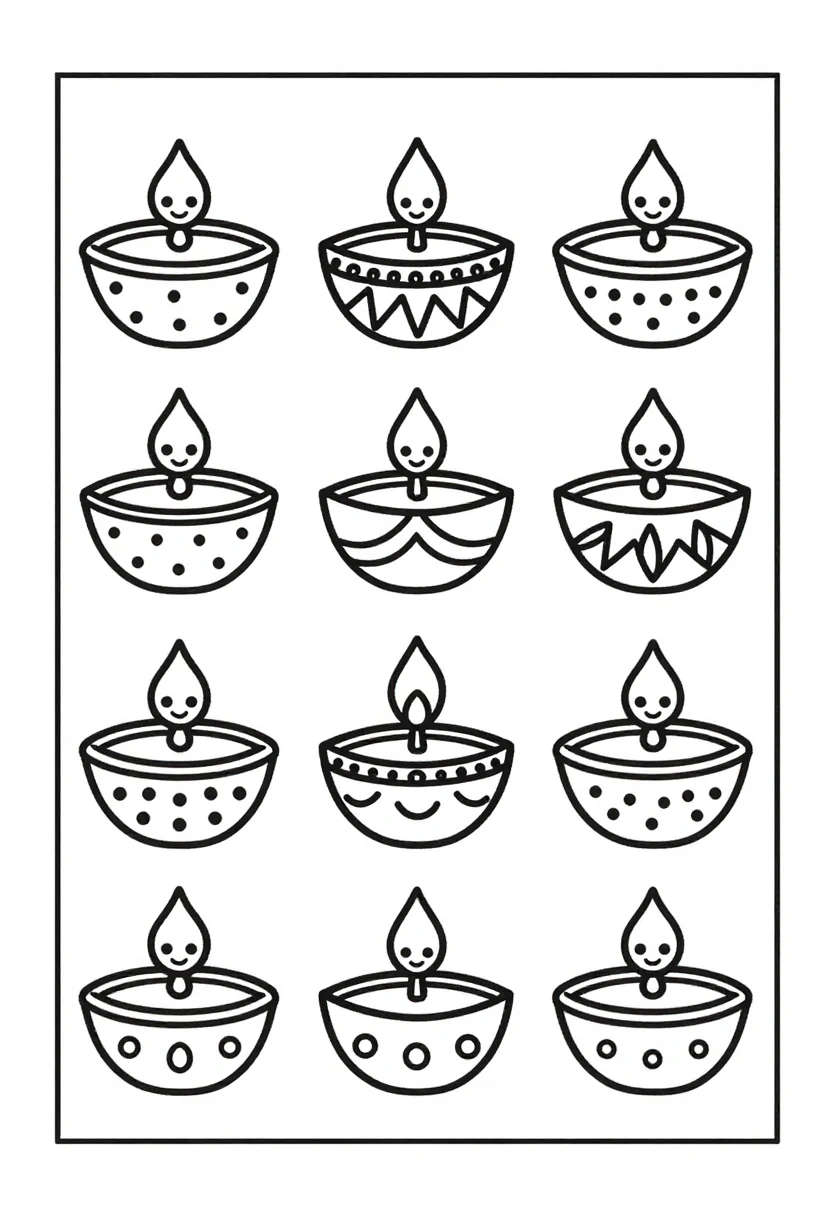
Printable coloring pages of diyas, the clay lamps lit at Diwali and Karthigai Deepam, for children to colour at home or in class before the festival. Each is a clean black outline with large areas to fill: one large diya, a puja thali with three lamps, and a page of nine small diyas with simple patterns. The bold style suits little children, the mandala style older ones, and the cute style has smiling lamps.
- a colouring page for a child at home
- a classroom activity before the festival
- a quiet activity at a family puja
- a sheet for toddlers to colour
Frequently asked questions
- Which style is for which age?
- The bold style has extra-thick outlines for toddlers, the mandala style has finer bands of petals and dots for older children, and the cute style has rounded lamps with smiling faces.
- Can the pages be printed?
- Yes. Each is a black line drawing on pure white with no grey tones, so it prints clearly in black ink.
- What is on the puja thali page?
- A round thali holding three diyas, a small bell, flowers and a kumkum bowl.
- Can I ask for a different subject?
- Yes. The direction field takes a change such as a peacock diya or with rangoli. A direction you type is a request, not a promised result.
About toile
This page is a showcase and a starting point: nine samples already rendered, three readings of the pack crossed with three styles, each shown at the size and ratio it was made for. Take any of them further on the wall with a few words, or ask for all nine again under your own direction; a sign-in keeps what you make, and it is free while Toile is new. The recipe behind each sample — the subject, the style, the palette, the framing — travels with the image rather than staying private to the render: it is in the alt text of every sample and in the page's own structured data, so a search engine reads the same handles a person would.