/kwanzaa-coloring-pages · season
Kwanzaa coloring pages: kinara, seven symbols, seven principles

Make your ownKwanzaa coloring pages
Describe yours. We'll remake the whole pack your way.
More like this
the whole catalog →



every sample — three subjects, three styles ↓
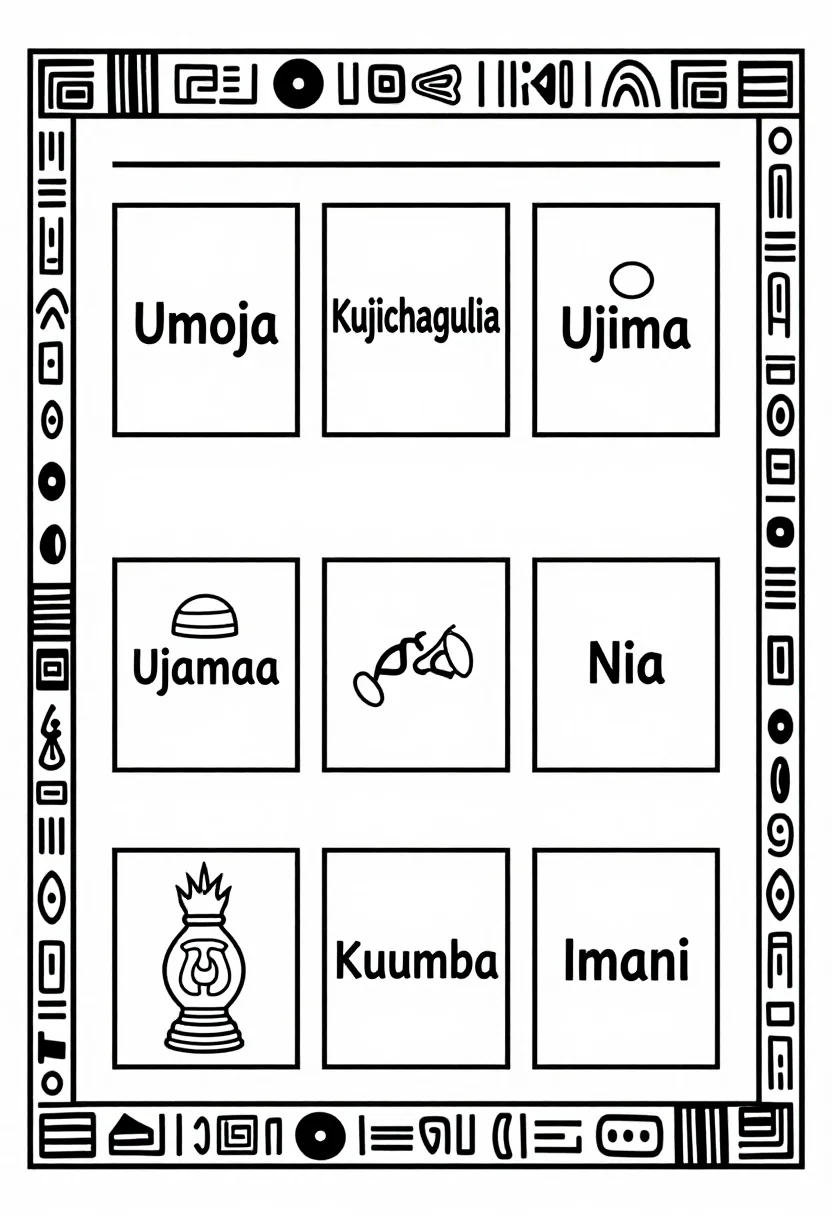
Printable Kwanzaa coloring pages for children to color through the seven days of Kwanzaa, 26 December to 1 January. The scenes are the kinara with its seven candles, the seven symbols on the woven mkeka, and a page of the seven principles, the Nguzo Saba, each in its own box. Bold and easy, kente pattern and an Adinkra border give the three looks.
- A holiday activity for the seven days
- A classroom lesson on the seven principles
- A family page for a Kwanzaa table
- A border page for a school wall
Frequently asked questions
- Does the principles page include the names?
- Yes. Each of the seven principles has its own box with its Swahili name and a small picture.
- What is the difference between the three styles?
- Bold and easy uses thick outlines for young children. Kente pattern fills the large shapes with fine kente-cloth stripes and zigzags for older children. Adinkra border frames the scene with repeating Adinkra symbols.
- Are the pages ready to print?
- Each is a flat black-and-white line drawing on white, with no shading or solid black fills, as in a coloring book.
- Can I ask for a different scene?
- Yes. Type a direction such as harvest basket and the page is drawn for it. It is a request, not a promised page.
About toile
This page is a showcase and a starting point: nine samples already rendered, three readings of the pack crossed with three styles, each shown at the size and ratio it was made for. Take any of them further on the wall with a few words, or ask for all nine again under your own direction; a sign-in keeps what you make, and it is free while Toile is new. The recipe behind each sample — the subject, the style, the palette, the framing — travels with the image rather than staying private to the render: it is in the alt text of every sample and in the page's own structured data, so a search engine reads the same handles a person would.